District of Columbia
Learn more about suicide and prevention efforts in District of Columbia, including a list of laws enacted in AFSP's top priority areas. Updated: June 2026.
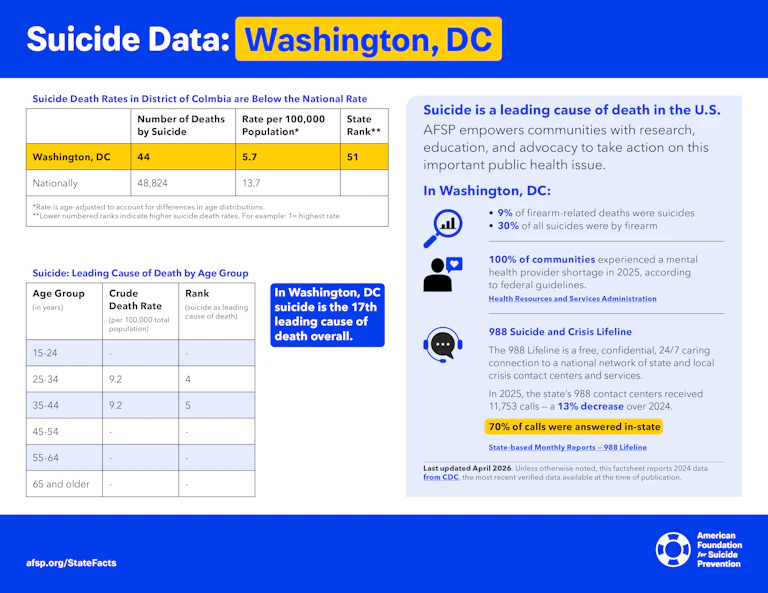
District of Columbia suicide prevention plans and initiatives
The D.C. Department of Behavioral Health (DBH) directs the District’s suicide prevention efforts and is home to the Access HelpLine center, which is a member of the 988 Suicide & Crisis Lifeline network. The 24/7 line is staffed by behavioral health professionals and offers mobile crisis team services. The District Department of Transportation recently began efforts to install barriers on the pedestrian railings of the William Howard Taft Bridge following city-wide advocacy, with key contributions from AFSP-National Capital Area.
District of Columbia laws
Key:
- Required by law
- Encouraged by law
- No law in place
Crisis lines and 988 implementation
- Addresses 988 infrastructure and provides for telecom user fee
- Addresses 988 infrastructure but does not include telecom user fee
- 988 law limited to creating an exploratory commission, advisory committee, or task force
K – 12 school suicide prevention
- Inclusion of the 988 Suicide & Crisis Lifeline and/or other crisis line(s) on student ID cards
- Student allowances for excused mental health absences
- School personnel must report student suicide risk to a parent and/or guardian
- Suicide prevention and/or mental health training for certain school personnel, annual
- Suicide prevention and/or mental health training for certain school personnel, not annual
- Suicide prevention, intervention, and postvention policies/programming
- Student education on suicide prevention
University and college campus suicide prevention
- Inclusion of the 988 Suicide & Crisis Lifeline and/or other crisis line(s) on student ID cards
- Students receive information on available mental health and/or suicide prevention services and/or resources
- Adoption of suicide prevention/awareness policy or program
Firearms
- Process for extreme risk protection orders (ERPOs)
- State voluntary do not sell list
Health professional training in suicide assessment, treatment and management
- Mental health professionals receive regular training
- Mental health professionals receive one time training
- Medical/surgical professionals receive regular training
- Medical/surgical professionals receive one time training
Conversion therapy bans
- Prohibits licensed/board certified mental health providers from engaging in conversion therapy with minors under 18 years of age
- Prohibits licensed/board certified mental health providers from engaging in conversion therapy with vulnerable adults
- Prohibits use of state funds for any purpose related to conversion therapy (e.g., conducting, making a referral for, or extending health benefits coverage for)
Advocate for suicide prevention
Learn how our volunteer Field Advocates are helping to pass suicide prevention legislation and policies that can save lives