New York
New York suicide prevention plans and initiatives
The New York State Office of Mental Health (OMH) houses the Suicide Prevention Center of New York (SPCNY) and is tasked with developing suicide prevention plans, programs, and services as well as advancing research and prevention efforts(§ 7.07 (g)). OMH SPCNY is also responsible for periodically reviewing state suicide prevention programs to ensure that the needs of individuals at risk of suicide are being met (§ 7.07 (h)). OMH also leads several grant-funded projects such as the ‘MISSION’ project, a 5-year initiative to strengthen school-based suicide prevention in Staten Island.
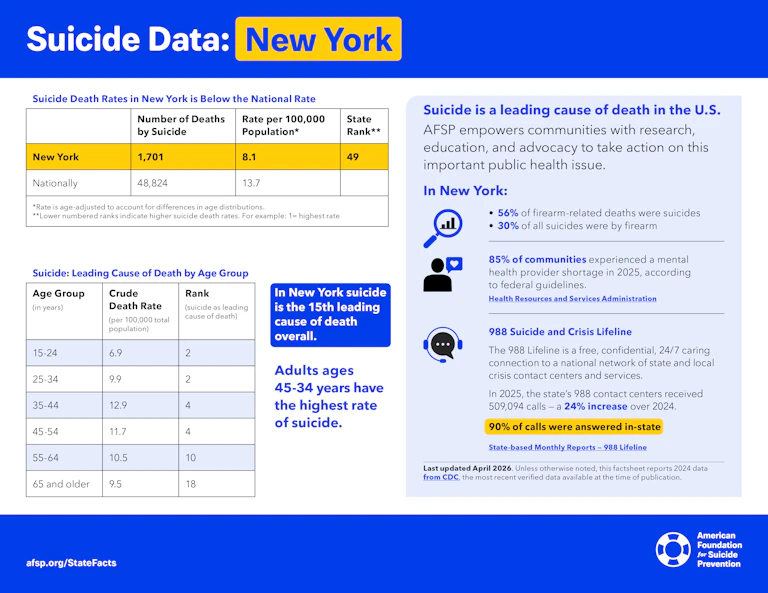
In 2025, OMH SPCNY, with contributions from AFSP-New York chapters, released the most recent suicide prevention plan, 1,700 Too Many: New York State’s Strategy for Suicide Prevention 2026-2030, with three guiding themes: (1) advance suicide prevention for populations at higher or rising risk through effective data; (2) center the voices of those with lived experience to ensure efforts are relevant and accessible; and (3) apply innovative research methods and data sources to strengthen accuracy and impact. The plan was developed in collaboration with the New York State Suicide Prevention Council, including AFSP-New York chapters, which serves as an advisory board to OMH SPCNY. The plan is packaged together with a 2026 New York State Suicide Prevention Task Force report on reducing suicide disparities and a comprehensive action plan for actualizing the state plan over the years 2026-2030. Visit preventsuicideny.org/roadmap to learn more and access all three resources.
In 2017, the Task Force was initiated by former Governor Cuomo to enhance state plan efforts by: (1) examining current programs, services, and policies related to suicide prevention and identifying gaps; and (2) making recommendations to facilitate greater access, awareness, collaboration, and support of effective suicide prevention activities. In 2019, the Task Force released the Communities United for a Suicide Free New York report with their recommendations. In 2020, former Governor Cuomo, through the 2020 State of the State Address, also directed OMH to establish a committee of veterans, military, law enforcement, corrections officers, EMS and firefighters, to address suicide prevention among this high-risk population. Governor Hochul announced $2 million in 2025 to support suicide prevention efforts for veterans and uniformed personnel.
New York laws
Key:
- Required by law
- Encouraged by law
- No law in place
Crisis lines and 988 implementation
- Addresses 988 infrastructure and provides for telecom user fee
- Addresses 988 infrastructure but does not include telecom user fee
- 988 law limited to creating an exploratory commission, advisory committee, or task force
K – 12 school suicide prevention
- Inclusion of the 988 Suicide & Crisis Lifeline and/or other crisis line(s) on student ID cards
- Student allowances for excused mental health absences
- School personnel must report student suicide risk to a parent and/or guardian
- Suicide prevention and/or mental health training for certain school personnel, annual
- Suicide prevention and/or mental health training for certain school personnel, not annual
- Suicide prevention, intervention, and postvention policies/programming
- Student education on suicide prevention
- Student education on mental health
University and college campus suicide prevention
- Inclusion of the 988 Suicide & Crisis Lifeline and/or other crisis line(s) on student ID cards
- Students receive information on available mental health and/or suicide prevention services and/or resources
- Adoption of suicide prevention/awareness policy or program
Firearms
- Process for extreme risk protection orders (ERPOs)
- State voluntary do not sell list
Health professional training in suicide assessment, treatment and management
- Mental health professionals receive regular training
- Mental health professionals receive one time training
- Medical/surgical professionals receive regular training
- Medical/surgical professionals receive one time training
Conversion therapy bans
- Prohibits licensed/board certified mental health providers from engaging in conversion therapy with minors under 18 years of age
- Prohibits licensed/board certified mental health providers from engaging in conversion therapy with vulnerable adults
- Prohibits use of state funds for any purpose related to conversion therapy (e.g., conducting, making a referral for, or extending health benefits coverage for)