It’s Okay to Ask for Help: Understanding Mental Health and Indigenous Peoples
June 30, 2026 – 5 min read
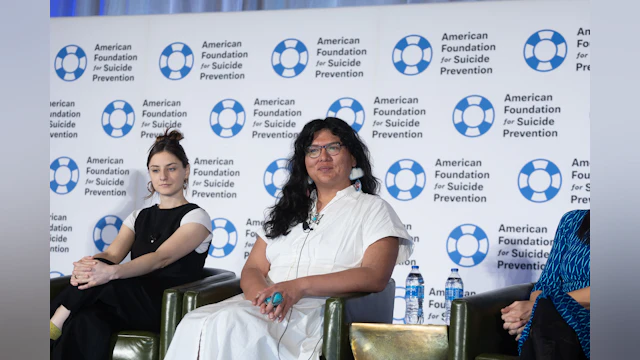
Before I became a Lifesaver Ambassador for the American Foundation for Suicide Prevention (AFSP), I rarely, if ever, talked about mental health with anyone. Mental health was a topic my family avoided in our everyday conversations. However, within the last few years, my family and I have been forced to talk about mental health because of the increased deaths by suicide in my family and instances of suicide ideation from close relatives. There was a crisis in my family, and we needed to do something.
My mother, sister, myself, and younger siblings began holding weekly family check-ins. Each week, for one hour, we gather and ask each other the following questions: how are you? What are you looking forward to this week, and what kind of support do you need? During this time together, we encourage each other and celebrate our wins. We give family updates, ask how we have been and if there is anything we are struggling with. This is a time for us to be together as a family and talk to one another.
Since we started our family check-ins, I have noticed my family being more vulnerable and braver with their thoughts and emotions. Sometimes we struggle, sometimes there’s conflict, but we’re still learning about mental health, growing as individuals, and figuring out how to advocate for ourselves and others.
Thankfully, I was not alone in all of this. AFSP has provided resources and insight, campaigns like Talk Away The Dark, and opportunities to be involved in a community that cares and understands the importance of mental health. AFSP cares and recognizes that Indigenous Peoples, among other marginalized communities, deserve to be supported and cared for.
The Mental Healthcare of Indigenous Peoples
As a citizen of a Native Nation, I understand our lives as Indigenous Peoples are shaped and impacted by historical and current socio-political systems. There is both a hesitation and resistance to mental healthcare in Indigenous communities. We know that Indigenous Peoples and other marginalized communities often experience disproportionate inequities in mental health care, support, services, and advocacy.[i] There is no direct reasoning, but historical complications, broken promises from the federal government, and instances of violence from non-Natives has increased mistrust between Indigenous Peoples and social institutions.[ii]
Further, Indigenous Peoples have experienced historical trauma, which exacerbates their already debilitating health conditions. Historical trauma is a collective traumatic event specific to a community because of their racial, ethnical, and/or cultural background.[iii] Due to their unique socio-political status within the census of the American population, Indigenous Peoples have experienced government oversight that has fundamentally hindered them from being successful within American society (Meriam Report, 1928). There has been an institutional unwillingness that has continued in today’s social system towards Indigenous Peoples, which has limited our access to affordable and comprehensive healthcare, specifically mental health.
There is limited research on the mental health experiences of Indigenous Peoples. However, we know that suicide is the ninth leading cause of death for Indigenous Peoples.[iv] Indigenous Peoples are more likely than any other group of community to know someone who has thought about, attempted, or died by suicide. In a recent study, Goetz, Mushquash, and Maranzan (2023) identified other known barriers of mental healthcare for Indigenous Peoples based on a review of previous studies, including:
- Structural obstacles such as limited access to mental health services, long waitlists, inability to access the care, and inexperienced staff
- Stigma and shame about mental health disorders and illnesses
- Self-reliance and uncertainty about the services being helpful or supportive
- Mistrust towards formal services and ignorant encounters
- Unawareness of mental health and lack of desire to learn more about mental health
This is the unfortunate mental healthcare (or lack of) reality for Indigenous Peoples (Goetz et al., 2023). There is a need for us as a community to do and be better at supporting our Indigenous Relatives, and we can.
Resources & Guidance
AFSP provides resources and is dedicated to working with diverse communities, organizations, and policy makers to ensure that mental health resources are available to all those in need. Together, we can make this world a little bit better than before. You can learn more about the resources that AFSP has available here.
However, as someone who is learning that it is okay to ask for help, here is some insight that I would share with someone just beginning to learn about mental health.
You Are Not Alone
Mental health is something everyone should be concerned about, because it impacts everyone. Please understand you are not alone and that there are people who have the language, who understand, and who care about you and your mental well-being. Some of us just need a little bit more support and that is okay.
Be Brave And Express Yourself
We all experience life in our own unique way, and we inherit history. Sometimes that history can negatively impact us and our well-being. For us, learning to be brave is often an act of defiance against a larger societal problem which had taught us to diminish ourselves to fit into the narratives of others. But I want to encourage you to be brave and express your joy, your sadness, your anger, everything that makes you…you.
Identify Support
If you’re like I once was, you may not be perfectly attuned to your own mental well-being, and unaware of the kind of support you might have. What I did was consider who is around me, and asked myself how comfortable I would be with talking to them about depression, emotions, stress, etc. And lastly, are they able and willing to support me? Your support system can be comprised of friends and family; but it is also important to have professional services (when available) or online resources and services, like crisis hotlines.
Everyone deserves to be loved, supported, and cared for. Mental healthcare is one of many ways we can achieve such a possibility. It is okay to ask for help.
[i] U.S. Department of Health and Human Services, Office of Minority Health. (n.d.). Mental and behavioral health: American Indians/Alaska Natives. https://minorityhealth.hhs.gov/mental-and-behavioral-health-american-indiansalaska-natives
[ii] Gone, J. P. (2022). Indigenous historical trauma: Alter-native explanations for mental health inequities. Daedalus, 151(3), 126–143. https://doi.org/10.1162/daed_a_02035
[iii] Brave Heart, M. Y. H. (1998). The return to the sacred path: Healing the historical trauma and historical unresolved grief response among the Lakota through a psychoeducational group intervention. Smith College Studies in Social Work, 68(3), 287–305.
[iv] Centers for Disease Control and Prevention. (2025). Health disparities in suicide. https://www.cdc.gov/suicide/disparities/index.htm